Structure and Development of the Economy
With its strategic location at the doorway to the Mainland and on the international time zone that bridges the time gap between Asia and Europe, the Hong Kong Special Administrative Region has been serving as a global centre for trade, finance, business and communications. Hong Kong is now ranked the ninth largest trading entity in the world. It operates the busiest container port in the world in terms of throughput, as well as one of the busiest airports in terms of number of passengers and volume of international cargo handled. In addition, it is the world's 10th largest banking centre in terms of external banking transactions, and the seventh largest foreign exchange market in terms of turnover. Its stock market is Asia's second largest in terms of market capitalisation.
 Hong Kong is characterised by a high degree of internationalisation, business-friendly environment, rule of law, free trade and free flow of information, open and fair competition, well-established and comprehensive financial network, superb network of transport and communications infrastructure, sophisticated support services, and a well-educated workforce complemented by a pool of efficient and enterprising entrepreneurs. Added to these is the substantial amount of fiscal reserves and foreign exchange reserves, a fully convertible and stable currency, and a simple tax system with low tax rate. On these virtues, Hong Kong is widely regarded as amongst the freest and most competitive economies in the world. The US Heritage Foundation ranks Hong Kong as the world's freest economy for the eighth year in a row in 2002. The Cato Institute in the United States, in conjunction with 50 independent research institutes in other countries, also rank Hong Kong as the freest economy in the world. The World Economic Forum, based in Switzerland, ranks Hong Kong as the third most competitive economy in Asia and the 13th in the world.
Over the past two decades, the Hong Kong economy has more than doubled in size, with GDP growing at an average annual rate of 5.0 per cent in real terms. This outpaced considerably the growth of the world economy and of the Organisation for Economic Co-operation and Development (OECD) economies. Over the same period, Hong Kong's per capita GDP has doubled, giving an average annual growth rate of 3.6 per cent in real terms. Its level at US$24,100 in 2001 was amongst the highest in Asia, next only to Japan (Chart 1).
| Gross Domestic Product (year-on-year rate of change in real terms) |
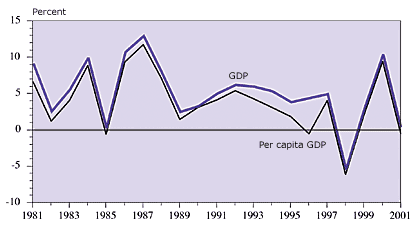 |
| Between 1981 and 2001, Hong Kong's GDP has grown by an annual average of 5.0% in real terms. The corresponding growth rate per capita GDP was 3.6%. The double dips occurring in 1998 and 2001 mainly reflected the adverse impact of the Asian financial crisis and the global economic downturn in these two years. |
In line with the increasing external orientation of the Hong Kong economy, trade in goods and trade in services expanded rapidly, by about eight times and four times respectively over the past two decades. The total value of visible trade (comprising re-exports, domestic exports and imports of goods) reached $3,052 billion in 2001, corresponding to 242 per cent of GDP. This was distinctly larger than the ratios of 153 per cent in 1981 and 232 per cent in 1991. If the value of exports and imports of services is also taken into account, the ratio is even greater, at 282 per cent in 2001, compared to 187 per cent in 1981 and 271 per cent in 1991.
As another indication of the high degree of external orientation, the stock of inward direct investment in Hong Kong amounted to $3,551 billion in market value at end-2000, equivalent to 280 per cent of GDP. Hong Kong is the second most favoured destination for inward direct investment in Asia, next only to the Mainland. The corresponding figures for the stock of outward direct investment in Hong Kong were likewise substantial, at $3,028 billion and 239 per cent, much larger than those for all the other economies in the region.
The Gross National Product (GNP), comprising GDP and net external factor income flows, stood at $1,299 billion in 2001. This was higher than the corresponding GDP by 2.9 per cent, owing to sustained net inflow of external factor income. In gross terms, inflows and outflows of external factor income continued to be substantial in 2001, at $374 billion and $338 billion respectively, or 30 per cent and 27 per cent of GDP. This was largely related to the huge volume of both inward and outward investment in Hong Kong.
Contributions of the Various Economic Sectors
The relative importance of various economic sectors can be assessed in terms of their respective value-added contribution to GDP and share in total employment. By both measures, primary production (including agriculture, fisheries, mining and quarrying) is insignificant in Hong Kong, as its development is much constrained by the limited endowment of natural resource and the relative land scarcity.
Secondary production (comprising manufacturing, construction, and supply of electricity, gas and water), which constituted a significant contributor to GDP up to the early 1980s, has dwindled in relative importance since then. Within this broad sector, the value-added contribution from manufacturing shrank noticeably, from 24 per cent in 1980 to 18 per cent in 1990 and even more to only 6 per cent in 2000, consequential to the ongoing relocation of the more labour-intensive production processes to the Mainland. Also relevant was the concurrent rapid expansion in the services sector, along with an upsurge in re-export and transhipment trade, tourism and financial services, as well as sustained growth in domestic demand. As to the construction sector, its contribution to GDP shrank from 7 per cent in 1980 to 5 per cent in 1990, and stayed at roughly the same level thereafter. The corresponding share for supply of electricity, gas and water nevertheless showed a gradual pick-up, from 1 per cent in 1980 to 2 per cent in 1990 and further to 3 per cent in 2000 (Chart 2).
| Gross Domestic Product by broad economic sector |
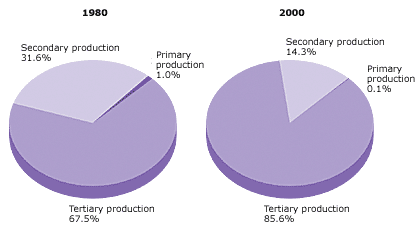 |
| Reflecting a profound shift in economic structure, the share of the tertiary services sector in GDP has been on a sustained rise over the past two decades, in parallel with a continued shrinkage in the share of the secondary sector. |
The open door policy and economic reform in the Mainland have not only provided an enormous production hinterland and market outlet for Hong Kong's manufacturers, but have also created abundant business opportunities for a wide range of service activities. These activities include specifically freight and passenger transport, travel and tourism, telecommunications, banking, insurance, real estate, and professional services such as financial, legal and accounting services. In consequence, the Hong Kong economy has become increasingly service-oriented since the 1980s.
Reflecting this, the share of the tertiary services sector (comprising the wholesale, retail and import/export trades, restaurants and hotels; transport, storage and communications; financing, insurance, real estate and business services; community, social and personal services; and ownership of premises) in GDP went up visibly, from 67 per cent in 1980 to 74 per cent in 1990 and further to 86 per cent in 2000.
The profound change in the economic structure was also manifested by a shift in the sectoral composition of employment. Over the past two decades, the share of the services sector in total employment followed a continuous uptrend, rising from 50 per cent in 1981 to 66 per cent in 1991 and further to 83 per cent in the first three quarters of 2001. Yet the corresponding share for the manufacturing sector kept on declining markedly, from 39 per cent in 1981 to 25 per cent in 1991 and further to only 7 per cent in the first three quarters of 2001 (Chart 3).
| Employment by broad economic sector |
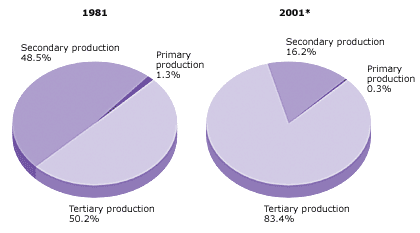 |
| Upon ongoing relocation of the less skill-intensive and lower value-added manufacturing processes to the Mainland, and with the strong expansion in service activities in Hong Kong, the tertiary services sector has overtaken the secondary sector to become the largest employer in the economy since 1981. * Average of Q1 to Q3 2001. |
The Services Sector
The services sector has not only flourished but also diversified in types of activities, concomitant with the structural transformation of the economy. Amongst the various service industries, community, social and personal services, and finance and business services, such as banking, insurance, real estate and a host of related professional services, have grown distinctly over the past two decades. Strong expansion was also observed in telecommunications services in the more recent years, especially those pertaining to information technology and Internet applications, in line with the shift in economic structure more towards knowledge-based activities.
On trade in services, exports and imports of services both went up by an annual average of 7 per cent in real terms over the past two decades. In 2000, civil aviation, travel and tourism, trade-related services, and various financial and banking services were the largest components of trade in services. Within exports of services, transportation was the most important component, accounting for 36 per cent of the total value in 2000. This was followed by offshore trading and purchasing/merchandising services (with a share of 30 per cent), travel and tourism (18 per cent), and financial and banking services (9 per cent). As to imports of services, travel and tourism were the largest component, accounting for 54 per cent of the total value in 2000. Transportation was in the second place (with a share of 21 per cent), followed by offshore trading and purchasing/merchandising services (8 per cent), and financial and banking services (6 per cent).
Between 1990 and 2000, the net output or value-added of the services sector rose appreciably, by an annual average of 9 per cent in value terms. Amongst the major constituent sectors, the net output of community, social and personal services had the fastest growth (at an average annual rate of 12 per cent). This was followed by financing, insurance, real estate and business services (9 per cent), transport, storage and communications (9 per cent), and the wholesale, retail and import/export trades, restaurants and hotels (8 per cent).
In 2000, the wholesale, retail and import/export trades, restaurants and hotels were still the largest contributor to GDP, accounting for 26 per cent of the total value-added contribution. This largely reflected the robust performance of external trade and inbound tourism in that year. Financing, insurance, real estate and business services came next (with a share of 23 per cent), aided by the buoyant stock market and continued expansion in fund management and insurance services. Further down in ranking were community, social and personal services (21 per cent), and transport, storage and communications (10 per cent) (Chart 4).
| Gross Domestic Product by major service sector |
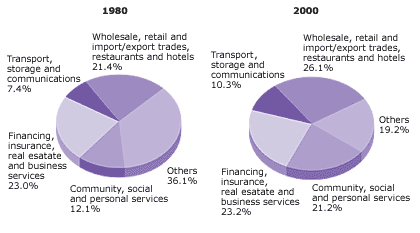 |
| Amongst the major constituent sectors, the wholesale, retail and import/export trades, restaurants and hotels, together with financing, insurance, real estate and business services, were the two largest contributors to GDP. |
Measured in terms of employment, the wholesale, retail and import/export trades, restaurants and hotels again topped the list, accounting for 32 per cent of the total employment in the first three quarters of 2001. This was followed by community, social and personal services (with a share of 25 per cent), financing, insurance, real estate and business services (15 per cent), and transport, storage and communications (11 per cent) (Chart 5).
| Employment by major service sector |
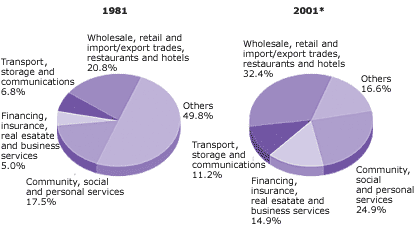 |
| Over the past two decades, the wholesale, retail and import/export trades, restaurants and hotels, as well as community, social and personal services, were the two largest employers in the economy. * Average of Q1 to Q3 2001. |
The Manufacturing Sector
Manufacturing firms in Hong Kong are renowned for their versatility and flexibility. The existence of many small establishments, connected under an extensive local sub-contracting network, has greatly facilitated producers in coping with changing demand conditions in the overseas markets. Moreover, through increased outward processing arrangements in the Mainland, Hong Kong's productive capacity has effectively been expanded by multiples, which has helped maintain the price competitiveness of its products. A predominant proportion of Hong Kong's manufacturing output is destined for export.
Besides relocating the more labour-intensive production processes to the Mainland, Hong Kong's manufacturers have also been striving hard to diversify their products and markets, in face of increased challenges from globalisation of trade and keener competition from other export producers. Concurrently, productive efficiency and product quality have been continuously upgraded by incorporating more advanced skills and technology.
Within the local manufacturing sector, textiles and clothing remain the most important industries, notwithstanding continued decline in their relative significance over the years. Other major industries include machinery and equipment, printing and publishing, electronics, food processing and metal products. Generally speaking, those manufacturing operations still remaining in Hong Kong are more knowledge-based and engender higher value-added with a greater technology content. Between 1991 and 2001, labour productivity in the local manufacturing sector, as measured by the ratio of the industrial production index to the manufacturing employment index, rose markedly, by an average of about 9 per cent per annum (Chart 6).
| Output per person engaged in the local manufacturing sector (March 1991 = 100) |
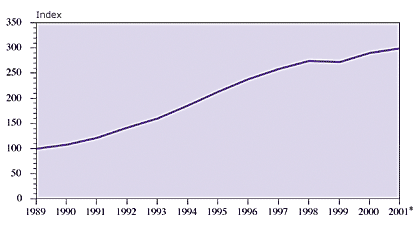 |
| Labour productivity in the local manufacturing sector has remained generally on an uptrend over the past decade. * Average of Q1 to Q3 2001. |
In 2001, the Mainland regained its position as the largest market for Hong Kong's domestic exports (with a share of 32 per cent), just ahead of the United States (31 per cent). Other major markets were distinctly behind, including the United Kingdom (6 per cent), Germany (4 per cent), Taiwan (3 per cent) and Japan (3 per cent). In the more recent years, new markets were also developed for Hong Kong's exports, including markets in the Middle East, Eastern Europe, Latin America and Africa.
Increasing Economic Links between the HKSAR and the Mainland
Since the Mainland adopted economic reform and an open door policy in 1978, economic links between Hong Kong and the Mainland have grown from strength to strength. This has brought about substantial economic benefits to both places.
Visible trade between Hong Kong and the Mainland has expanded rapidly since 1978, by an annual average of 23 per cent in value terms. However, the growth in two-way trade moderated visibly in the more recent years, from an annual average of 16 per cent in value terms during 1991-1996 to that of 3 per cent during 1996-2001, amidst increasing direct shipment of goods into and out of the Mainland upon the enhanced port facilities and simplified customs procedures there. This notwithstanding, the Mainland remained as Hong Kong's largest trading partner in 2001, accounting for 40 per cent of Hong Kong's total trade value. The bulk (specifically, 90 per cent) of Hong Kong's re-export trade was related to the Mainland, making it the largest market for as well as the largest source of Hong Kong's re-exports. Reciprocally, Hong Kong was the Mainland's third largest trading partner in 2001 (after Japan and the United States), accounting for 11 per cent of the Mainland's total trade value (Chart 7).
| Hong Kong's visible trade with the Mainland |
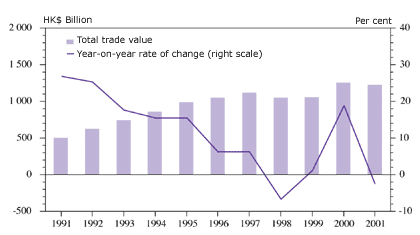 |
| Since the Mainland adopted an open door policy and economic reform in 1978, there has been a rapid expansion in merchandise trade, especially re-export trade, between Hong Kong and the Mainland. |
Over the past two decades, there has also been a sharp increase in invisible trade and investment flows between Hong Kong and the Mainland. At present, Hong Kong is a major service centre for the Mainland generally and South China in particular, providing a wide array of financial and other business support services like banking and finance, insurance, transport, accounting and sales promotion. It is also a principal gateway to the Mainland for business and tourism. In 2001, 52 million trips were made by Hong Kong residents to the Mainland, 4 per cent more than in 2000. The number of trips made by foreign visitors to the Mainland through Hong Kong also went up, by 6 per cent to three million.
Hong Kong has been the largest source of external direct investment in the Mainland. According to an official source in the Mainland, the cumulative value of Hong Kong's realised direct investment there amounted to US$187 billion at end-2001, accounting for about half of its total inward direct investment. Over the years, there has been a noticeable shift in the composition of Hong Kong's direct investment across the boundary, from industrial processing to a wider spectrum of business ventures such as hotels and tourist-related facilities, real estate and infrastructure development. Relative to other places in the Mainland, Hong Kong's economic links with Guangdong Province are much more intimate. At end-2000, the cumulative value of Hong Kong's realised direct investment in Guangdong was estimated at US$72 billion, accounting for nearly three-quarters of its total inward direct investment. Currently, over five million Chinese workers are said to be employed in the province by industrial ventures with Hong Kong interests. This is about 24 times the size of Hong Kong's own manufacturing workforce.
In
the opposite direction, there has likewise been a sizeable flow of investment
capital from the Mainland to Hong Kong over the past years. By end-2000,
the Mainland had invested a total of US$143 billion in Hong Kong, making
it one of the largest sources of external direct investment. More than
In tandem with the upsurge in
cross-boundary flows of trade, investment and people, financial links
between Hong Kong and the Mainland have also been growing at a generally
strong pace over the past two decades. Yet affected by a slowdown in economic
growth, there was a distinct slackening in 2001. Comparing end-2001 with
a year earlier, external liabilities of Hong Kong's authorised institutions
(AIs) to entities in the Mainland fell by 15 per cent to $334 billion,
while external claims of Hong Kong's AIs on entities in the Mainland contracted
by 10 per cent to $198 billion. Nevertheless, these external liabilities
and claims against entities in the Mainland were still well above those
of $125 billion and $135 billion respectively in mid-1991 when such statistics
were first compiled.
The Bank of China (Hong Kong) is the second largest banking group in Hong Kong after the HSBC Group. It was established on October 1, 2001 through restructuring 10 member banks of the former Bank of China Group. It has taken on the issuance of Hong Kong dollar banknotes, as was hitherto performed by the former Bank of China since May 1994. (The other two note-issuing banks are the Hongkong and Shanghai Banking Corporation and the Standard Chartered Bank.) The other three state-owned commercial banks, namely the China Construction Bank, the Agricultural Bank of China, and the Industrial and Commercial Bank of China, were all granted banking licences to operate in Hong Kong in 1995. Meanwhile, the HSBC Group, the Bank of East Asia and the Standard Chartered Bank continue to be amongst the best-represented foreign banks in the Mainland.
Hong Kong has been serving as a major funding centre for the Mainland. Apart from being a direct source of funds, it also renders a window through which foreign funds can be channelled efficiently into the Mainland for financing development projects there. So far, most of the Mainland's fund-raising activities in Hong Kong have taken the form of syndicated loans. But more recently, an increasing number of Mainland-related banks and enterprises have raised funds through issuance of negotiable certificates of deposit, bonds and shares. Since mid-1993, H shares have been listed on Hong Kong's stock exchange by an increasing number of large state-owned enterprises (SOEs) in the Mainland. At end-2001, a total of 50 SOEs were so listed in the Main Board of the Hong Kong Stock Exchange, raising a total equity capital of $127 billion. Of these 50 enterprises, three were listed in 2001, raising $6.1 billion. Another eight SOEs and one non-SOE were listed in the Growth Enterprise Market (GEM) set up in November 1999, raising a total equity capital of $1.8 billion.
With
continuing reform and further liberalisation of the Mainland economy,
particularly upon China's entry into the World Trade Organisation, more
foreign investment can be expected to flow into the Mainland. Hong Kong's
role as a major funding and services centre for the Mainland will hence
be sustained in the years to come.