Structure and Development of the Economy
With its strategic location at the doorway to the Mainland and on the international time zone that bridges the time gap between Asia and Europe, the Hong Kong Special Administrative Region (HKSAR) has been serving as a global centre for trade, finance, business and communications. Hong Kong is ranked the eighth-largest trading entity in the world. It operates one of the busiest container ports in the world in terms of throughput, and also one of the busiest airports both in terms of the number of passenger and volume of international cargo handled. It is the world's eighth-largest banking centre in terms of external banking transactions, and the seventh-largest foreign exchange market in terms of turnover. Its stock market is Asia's second-largest in terms of market capitalisation.
Hong Kong is characterised by its high degree of internationalisation, business-friendly environment, rule of law, free trade and free flow of information, open and fair competition, well-established and comprehensive financial network, superb network of transport and communications infrastructure, sophisticated support services, and a well-educated workforce complemented by a pool of efficient and enterprising entrepreneurs. Added to these are the substantial amount of fiscal reserves and foreign exchange reserves, a fully convertible and stable currency, and a simple tax system with low tax rate.
On these virtues, Hong Kong is widely regarded as among the freest and most competitive economies in the world. In 1998, for the fifth year in a row, the Heritage Foundation of the USA ranked Hong Kong as the world's freest economy. The Cato Institute in the USA - in conjunction with 53 independent research institutes in other countries - also named Hong Kong the freest economy in the world. The World Economic Forum ranks Hong Kong as the world's second most-competitive economy.
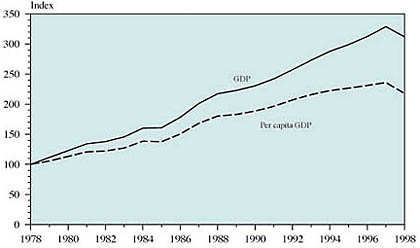
Over the past two decades, the Hong Kong economy has more than tripled. GDP in Hong Kong has been growing at an average annual rate of about 6 per cent in real terms, to $789 billion in 1998. This growth was twice as fast as for the world economy and outperformed the Organisation for Economic Co-operation and Development (OECD) economies. Per capita GDP in Hong Kong has more than doubled in real terms, equivalent to an average annual real growth rate of about 4 per cent. In 1998, it reached US$24,900. The latest comparison showed that per capita GDP in Hong Kong was among the highest in Asia, next only to Japan.
|
Chart 1:
Gross Domestic
Product (1978 = 100) |
|
 |
|
| Over the past two decades, the Hong Kong economy has been expanding rapidly, with GDP growing by 6% per annum and per capita GDP by 4% per annum in real terms. |
Trade in goods and services expanded by about 11 times and four times respectively over the past two decades. Reflecting the highly externally-oriented nature of the Hong Kong economy, the total value of visible trade (comprising re-exports, domestic exports and imports) amounted to $2,780 billion in 1998, representing 216 per cent of the GDP. This compared with the corresponding ratios of 143 per cent in 1970, 148 per cent in 1980, and 221 per cent in 1990. If the value of exports and imports of services is also taken into account, the ratio is even higher, at 250 per cent in 1998, as compared to 181 per cent in 1970, 181 per cent in 1980, and 260 per cent in 1990.
External investment has played an important role in Hong Kong's economic development. The total stock of inward direct investments in Hong Kong reached $732.4 billion at end-1997, representing a significant increase of 17 per cent over end-1996. Of this, more than 90 per cent of the direct investment went to the non-manufacturing sectors. Analysed by major source, the UK remained the largest investor in Hong Kong, with a share of 25 per cent in the overall stock of inward direct investment at end-1997, followed by the Mainland (19 per cent), the USA (18 per cent), and Japan (13 per cent).
The Gross National Product (GNP), comprising GDP and net external factor income flows, rose markedly by 13.4 per cent in value terms to $1,351.6 billion in 1997. This was somewhat faster than the 12.8 per cent in value terms growth in GDP, due to a net factor income inflow to Hong Kong equivalent to about 0.6 per cent of GDP in that year. Reflecting the high degree of external orientation of the Hong Kong economy, both inflows and outflows of external factor income were very substantial, estimated at $461 billion and $453 billion respectively, each amounting to over one-third of GNP.
Contributions of the Various Economic Sectors
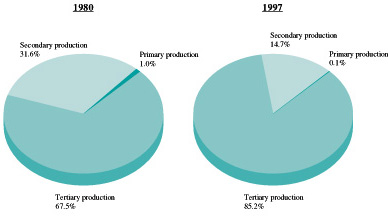
The relative importance of the various economic sectors can be reflected in their contributions to the GDP and to total employment. In the absence of natural resources, the contribution of primary production (agriculture and fisheries, mining and quarrying) to GDP and employment is negligible in Hong Kong.
|
Chart
2: Gross
Domestic Product by broad economic sector |
|
 |
|
| Over the years, the tertiary services sector has become increasingly important in terms of contribution to GDP. |
Within secondary production (comprising manufacturing; construction; and supply of electricity, gas and water), the contribution of the manufacturing sector to GDP declined significantly, from 24 per cent in 1980 to 18 per cent in 1990, and further to only 7 per cent in 1997. This was mainly on account of the continued development of the services sector in Hong Kong as well as the on-going relocation of the more labour-intensive manufacturing processes across the border since the mid-1980s. On the other hand, the share of the construction sector in GDP, having fallen from 7 per cent in 1980 to around 5 per cent in 1990, edged up to 6 per cent in 1997. The combined share of the supply of electricity, gas and water, at 2 per cent in 1997, was broadly similar to the average level of 3 per cent recorded over the past 10 years.
The open-door policy and economic reforms in the Mainland have not only provided a huge production hinterland and market outlet for local manufacturers, but have also created an abundance of business opportunities for a wide range of service activities in Hong Kong. These service activities include freight transport, telecommunications, banking, real estate development, and professional services such as legal, accounting and insurance services. Hence, since the mid-1980s, the Hong Kong economy has become increasingly oriented towards services.
Reflecting this, the share of the tertiary services sector (comprising the wholesale, retail and import/export trades, restaurants and hotels; transport, storage and communications; financing, insurance, real estate and business services; community, social and personal services; and ownership of premises) in GDP rose steadily, from around 67 per cent in 1980 to 74 per cent in 1990, and further to 85 per cent in 1997.
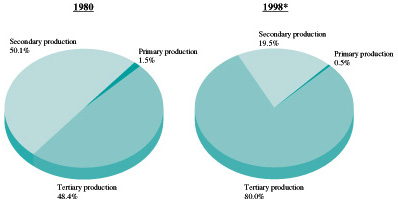
| Chart 3: Employment by broad economic sector | |
 |
|
| With
the on-going relocation of lower value-added and less skill-intensive
manufacturing processes to the Mainland and steady expansion of service
sector activities in Hong Kong, the tertiary services sector has long
overtaken the secondary production sector to become the largest employer
in the economy. *Average of Q1 to Q3 1998. |
This structural change in the economy was also shown up in the sectoral distribution of employment. The share of the services sector in total employment rose markedly, from 48 per cent in 1980 to 63 per cent in 1990, and further to about 80 per cent in 1998. On the other hand, the share of the manufacturing sector in total employment was on a distinct downtrend, dropping from 42 per cent in 1980 to 28 per cent in 1990, and further to only about 8 per cent in 1998.
The Services Sector
The services sector has flourished and diversified in types of activities amid the structural change in the economy. Among the service industries, the growth and development in finance and business services, including banking, insurance, real estate, and a wide range of other professional services, has been particularly rapid.
During the decade from 1989 to 1998, exports of services expanded by an annual average of 4 per cent in real terms, and that of imports of services by 6 per cent. The major components of Hong Kong's trade in services are civil aviation, shipping, travel and tourism, trade-related services, and various financial and banking services. The shares of transportation services in total exports and total imports of services were 35 per cent and 22 per cent respectively in 1997. The corresponding shares for travel and tourism were 24 per cent and 55 per cent. Trade-related services, including offshore trading and purchasing/merchandising services, took up 26 per cent of the total value of exports of services and 8 per cent of the total value of imports of services. The corresponding shares for financial and banking services were 6 per cent and 4 per cent.
Between 1987 and 1997, the net output or value-added of the services sector rose markedly, by an average of 15 per cent in value terms a year. Among them, financing, insurance, real estate and business services increased most rapidly (at an average annual rate of 18 per cent). This was followed by community, social and personal services (15 per cent); transport, storage and communications (14 per cent); and the wholesale, retail and import/export trades, restaurants and hotels (also 14 per cent).
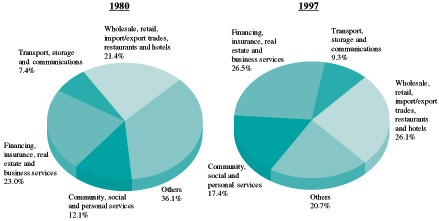
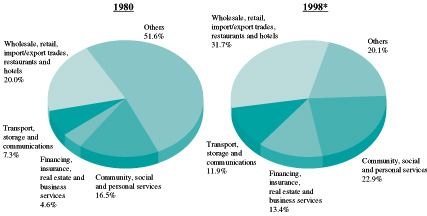
Financing, insurance, real estate and business services remained the largest contributor to GDP, accounting for 27 per cent of GDP in 1997. This was followed by the wholesale, retail and import/export trades, restaurants and hotels, contributing another 26 per cent to GDP in 1997. The share of community, social and personal services in GDP was 17 per cent, while that for the transport, storage and communications was 9 per cent.
| Chart 4: Gross Domestic Product by major service sector | |
 |
|
| The distributive and catering trades as well as financing, insurance, real estate and business services remained the largest segments of the services sector in terms of contribution to GDP. |
As to the contribution to total employment, the services sector took up about 80 per cent in 1998. Within this total, the wholesale, retail and import/export trades, restaurants and hotels was the largest employer, accounting for about 32 per cent of total employment in 1998. This was followed by community, social and personal services (23 per cent); financing, insurance, real estate and business services (13 per cent); and transport, storage and communications (12 per cent).
| Chart 5: Employment by major service sector | |
 |
|
| Over
the years, the distributive and catering trades, community, social
and personal services, as well as financing, insurance, real estate
and business services have become important employers in the services
sector. * Average of Q1 to Q3 1998. |
The Manufacturing Sector
Manufacturing firms in Hong Kong are renowned for their versatility. The existence of many small establishments, connected under an extensive local sub-contracting network, has greatly facilitated producers to cope with frequent changes in demand in the overseas markets. Furthermore, the increasing use of outward processing facilities in the Mainland has enabled Hong Kong's productive capacity to expand by multiples even amid the capacity constraint locally, and hence helped maintain the price competitiveness of Hong Kong's products. A predominant proportion of Hong Kong's manufacturing output is destined for export.
The pressure of protectionism in several major markets and growing competition from other economies in East Asia have led to even greater diversification in both products and markets, mainly on account of the sustained initiative and dedicated promotion efforts of both local manufacturers and exporters. To maintain competitiveness, product quality has also been continuously upgraded over the years.
Thus the local manufacturing sector has become increasingly diversified. Apart from the toys and electronics industries, the textiles and clothing industries remain prominent, notwithstanding their decline in relative importance. Other important industries include printing and publishing, machinery and equipment, fabricated metal products, plastic products, watches and clocks and jewellery. Those manufacturing operations staying in Hong Kong are generally more knowledge-based and with a higher value-added content, along with continued mechanisation and wider application of computer-aided technologies in the production process.
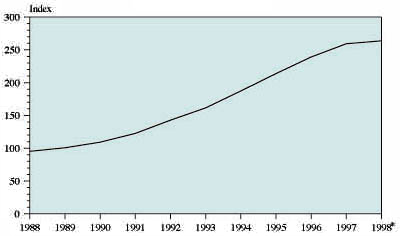
Coupled with increasing capital intensity in production, labour productivity in the manufacturing sector was able to improve significantly over the years. During the 10 years 1989 to 1998, labour productivity in the local manufacturing sector, as measured by the ratio of the industrial production index to the manufacturing employment index, increased by an average of around 11 per cent a year.
| Chart
6:
Output
per person engaged in the local manufacturing sector
(March 1991 = 100) |
|
 |
|
| Labour
productivity in the local manufacturing sector has been on a general
uptrend over the years. * Average of Q1 to Q3 1998. |
The Mainland was the largest market for Hong Kong's domestic exports, accounting for about 30 per cent of the total in 1998. This was followed by the USA (29 per cent), the UK (5 per cent), and Germany (also 5 per cent). In the more recent years, new markets were developed for Hong Kong's exports, including markets in the Middle East, Eastern Europe, Latin America and Africa.
Increasing Economic Links between the Hong Kong Special Administrative Region and the Mainland
Since the Mainland adopted economic reform and open-door policy in 1978, economic links between Hong Kong and the mainland of China have grown from strength to strength. This has brought about substantial economic benefits to both places.
Specifically, visible trade between Hong Kong and the Mainland has grown strongly since 1978, at an average annual rate of 26 per cent in value terms. However, reflecting the increasing trend of direct shipment of goods into and out of the Mainland along with the enhanced port facilities and simplified customs procedures there, the value of two-way trade grew at a more moderate pace in the more recent years, at an average of 12 per cent between 1992 and 1997. In 1998, the two-way trade was indirectly hit by the regional financial turmoil, and declined by 6 per cent. Re-exports and domestic exports to the Mainland were down by 8 per cent and 12 per cent respectively in 1998, while imports from the Mainland fell by 5 per cent. Notwithstanding the fall in the two-way trade, the Mainland remained Hong Kong's largest trading partner in 1998, accounting for 38 per cent of Hong Kong's total trade. Besides this, 90 per cent of Hong Kong's re-export trade was attributable to the Mainland, making it both the largest market for and the most significant source of Hong Kong's re-exports. Reciprocally, Hong Kong was the Mainland's third-largest trading partner in 1998 (just behind Japan and the USA), accounting for 14 per cent of the Mainland's total trade.
Over the past two decades, there has also been a substantial increase in invisible trade and investment flows between Hong Kong and the Mainland. At present, Hong Kong is a major service centre for the Mainland generally and South China in particular, providing a wide range of financial and business support services such as banking and finance, insurance, accounting, transport and warehousing. It is also a principal gateway to the Mainland for business and tourism. In 1998, 39 million trips were made by Hong Kong residents to the Mainland, representing an increase of 16 per cent over 1997. Yet the number of trips made by foreign visitors to the Mainland through Hong Kong was down by 6 per cent to 2.2 million in 1998, mainly due to the reduced number of visitors from within East Asia amid the regional financial turmoil.
Hong Kong has continued to be the largest source of external direct investment in the Mainland. At end-1998, the cumulative value of Hong Kong's realised direct investment in the Mainland was estimated at US$139 billion, accounting for about 52 per cent of the total value. There has been a notable shift in the composition of Hong Kong's direct investment in the Mainland in recent years, from industrial processing to a wider spectrum of business ventures such as hotels and tourist-related facilities, real estate and infrastructure development. Relative to other places in the Mainland, Hong Kong's economic links with Guangdong are much more intimate. At end-1998, the cumulative value of Hong Kong's realised direct investment in Guangdong was estimated at US$63 billion, accounting for about 77 per cent of the total for the province. Currently, more than five million Chinese workers are said to be employed in Guangdong by industrial ventures with Hong Kong interests. This is more than 18 times the size of Hong Kong's own manufacturing workforce.
In the opposite direction, there has likewise been
a sizeable flow of investment capital from the Mainland to Hong Kong.
By end-1997, the Mainland invested a total of US$18 billion in the territory,
making it the second-largest external investor, just after the UK. More
than
Along with the surge in two-way trade, investment and people flows, financial links between Hong Kong and the Mainland have also been on a rapid increase. By end-1998, the external liabilities of Hong Kong's authorised institutions to entities in the Mainland reached $291 billion, while their external claims on entities in the Mainland were even larger, at $324 billion. These represented decreases of 5 per cent and 21 per cent, respectively, over a year earlier. The Bank of China Group, which has been established here for decades, is the second-largest banking group in Hong Kong after the HSBC Group. It started issuing Hong Kong dollar banknotes in May 1994. The other three state-owned commercial banks - the China Construction Bank, the Agricultural Bank of China, and the Industrial and Commercial Bank of China - were granted banking licences to operate in Hong Kong in 1995. On the other hand, the HSBC Group, together with the Bank of East Asia and the Standard Chartered Bank, are among the best-represented foreign banks in the Mainland.
Moreover, Hong Kong has been a major funding centre for the Mainland. Apart from being a direct source of funds, Hong Kong also serves as a window through which foreign funds can be channelled efficiently into the Mainland for financing the various development projects there. So far, most of the Mainland's fund-raising activities in the territory have taken the form of syndicated loans. but more recently, an increasing number of Mainland-related banks and enterprises have raised funds through issuance of negotiable certificates of deposit, bonds and shares. Since mid-1993, H shares have been listed in Hong Kong's stock market by an increasing number of large state-owned enterprises in the Mainland. At end-1998, a total of 41 such enterprises were listed on the Hong Kong Stock Exchange, raising a total equity capital of $61 billion. The on-going restructuring of the Mainland's financial sector into a more rational and market-oriented system, in parallel with its continuing economic liberalisation on a wider front, will help attract more foreign investment there. Although fund-raising activities over the past year were constrained by the liquidity crunch in the region since mid-1997, Hong Kong's role as a major funding centre for the Mainland will be accentuated again when the regional financial situation returns to normal.