The Manufacturing Sector
Manufacturing firms in Hong Kong are well known for their versatility.
The existence of many small establishments, connected under an
extensive local sub-contracting network, has greatly aided producers to
cope with frequent changes in demand in the overseas markets.
Furthermore, the increasing use of outward-processing facilities in the
Mainland has enhanced the flexibility of productive capacity and helped to
maintain the price competitiveness of Hong Kong's products. A
predominant proportion of Hong Kong's manufacturing output is destined
for exports.
Over the years, protectionism in several major markets and growing
competition from other economies in East Asia have led to even greater
diversification in both products and markets. This is attributable to the
initiative of local manufacturers and exporters as well as their own
dedicated promotion efforts. To maintain competitiveness, there has also
been continuous upgrading of product quality.
In consequence, the local manufacturing sector has become more
diversified. In addition to the toys and electronics industries, the textiles
and clothing industries remain prominent, notwithstanding their declines
in relative importance. Other important industries include printing and
publishing, machinery and equipment, fabricated metal products, plastic
products, watches and clocks and jewellery. In a nutshell, those
manufacturing operations staying in Hong Kong are generally of higher
value-added or higher-technology nature, along with continued
mechanisation and wider application of computer-aided technologies in
the production process.
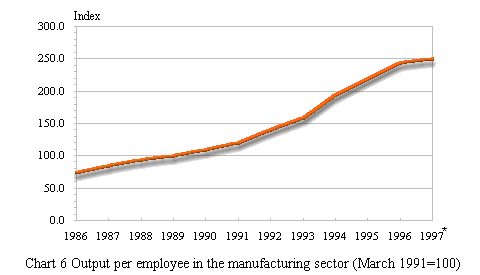
Partly due to growing capital intensity in production, labour productivity
in the manufacturing sector improved significantly over the years. During
the period 1986 to 1996, the value of net output by the manufacturing
sector grew by an average of 2 per cent per annum, notwithstanding that
manufacturing employment declined at an average annual rate of 10 per
cent. Even after taking into account the effect of price increases on the
output value, the improvement in labour productivity was still remarkable.
Chart 6 Output per employee in the
manufacturing sector
(March 1991=100) Output per employee in the manufacturing sector has
been on a general uptrend over the years.
*Average of Q1 to Q3 1997.
The Mainland was the largest market for Hong Kong's domestic exports,
accounting for about 30 per cent of domestic exports in 1997. This was
followed by the USA (26 per cent). The shares of the UK, Japan and
Germany were all at 5 per cent. Hong Kong's exports have also diversified
into new markets in recent years, including countries in the Middle East,
Eastern Europe, Latin America and Africa.
[Back] [Forward]
|