Contributions of the Various Economic Sectors
The relative importance of the various economic sectors can be assessed
in terms of their contributions to the GDP and to total employment. In the
absence of natural resources, the contribution of primary production
(agriculture and fisheries, mining and quarrying) to GDP and employment
is negligible in Hong Kong.
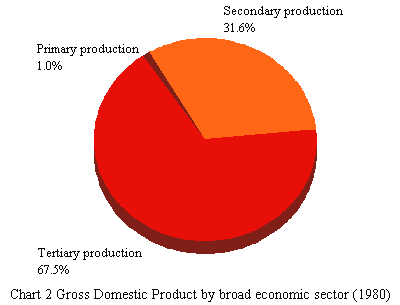
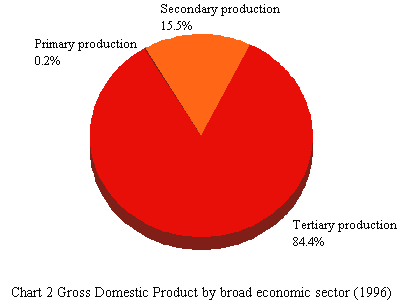
Chart 2 Gross Domestic Product by broad economic sector
Over the past 15 years, the tertiary services sector has
become increasingly important in terms of contribution to GDP.
(1980)
(1996)
Within secondary production (comprising manufacturing; construction;
and the supply of electricity, gas and water), the contribution of the
manufacturing sector to GDP declined steadily along with the continued
expansion of the service sectors and the on-going relocation of
manufacturing processes to the Mainland since the mid-1980s, from 24
per cent in 1980 to 18 per cent in 1990, and further to 7 per cent in 1996.
On the other hand, the share of the construction sector in GDP, having
fallen from 7 per cent in 1980 to around 5 per cent in 1985, has stayed at
around 5 per cent since then. The combined share of the supply of
electricity, gas and water, at 2 per cent in 1996, was broadly similar to
the average level of 3 per cent recorded over the past 10 years.
The open-door policy and economic reforms in the Mainland have not
only provided a huge production hinterland for local manufacturers, but
have also created an abundance of business opportunities for a wide range
of service activities in Hong Kong. These include freight transport,
telecommunications, banking, real estate development, and professional
services such as legal, accounting and insurance services. Hence, since
the mid-1980s, the Hong Kong economy has become increasingly oriented
towards services.
Reflecting this, the significance of the tertiary service sector as a whole
(comprising the wholesale, retail and import/export trades, restaurants and
hotels; transport, storage and communications; financing, insurance, real
estate and business services; community, social and personal services;
and ownership of premises) in terms of its contribution to GDP rose
steadily, from around 67 per cent in 1980 to 70 per cent in 1985 and 74
per cent in 1990, and further to 84 per cent in 1996.
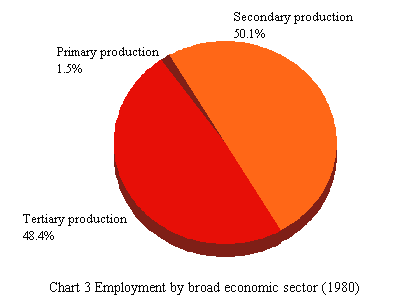
Chart 3 Employment by broad economic sector
With the on-going relocation of lower value-added and less skill-
intensive manufacturing processes to the Maninland and steady
expansion of service sector activities in Hong Kong, the tertiary
services sector has overtaken the secondary production
section to become the largest employer in the economy.
*Average of Q1 to Q3 1997.
(1980)
(1997*)
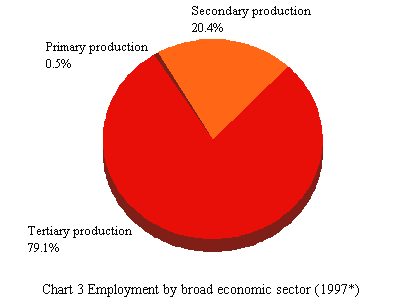
Employment in the economy also shifted towards services over time. The
tertiary service sector's share as a whole in total employment rose from
48 per cent in 1980 to 54 per cent in 1985, and further to about 79
per cent in 1997. On the other hand, the manufacturing sector's share in
total employment was on a distinct downtrend, dropping from 42 per cent
in 1980 to 36 per cent in 1985, and further to about 10 per cent in 1997.
[Back] [Forward]
|